

Learn how to make pie crust with this easy pie dough recipe! It yields a flaky, buttery crust that's perfect for using in your favorite homemade pies.


Meet my best pie crust recipe! I tested and tweaked this recipe to perfection a few years ago, and now, it’s the only one I use. I love it because the crust comes out tender and flaky every time. Made with 100% butter, it also has a delicious buttery flavor.
This pie crust recipe is easy to make. Adapted from J. Kenji López-Alt, it comes together in the food processor with 5 basic ingredients.
Below, I’m sharing the complete recipe, plus step-by-step photos and tips. Even if you’re new to making pie crust, you can master this recipe. I hope you love it as much as I do!

Pie Dough Ingredients
Here’s what you’ll need to make this easy pie crust recipe:
- All-purpose flour – I use 2 2/3 cups to make two crusts, enough for one 9- or 9.5-inch double crust pie or two single crust pies. Spoon and level your flour to avoid packing too much into your measuring cup!
- Cold butter – Many recipes call for a mix of butter and shortening (or even lard), but I prefer to make an all-butter pie crust. The flavor is richer, and the crust has a lovely flaky texture.
- Ice water – Cold water is key! It keeps the butter cold as you work with the dough.
- Apple cider vinegar – It makes the dough a little more flavorful. Plus, if you overwork the dough, developing the gluten in the flour, the vinegar will keep it tender instead of tough.
- And sea salt – To bring out the crust’s rich, buttery flavor.
Find the complete recipe with measurements below.
How to Make Pie Crust
In a traditional pie dough recipe, you’d cut the fat into the flour by hand or with a pastry cutter. Though you can make great crusts with this method, I prefer the one in this recipe. It’s more foolproof, and the dough is much more pliable.
Inspired by a technique that J. Kenji López-Alt developed at Cook’s Illustrated, it uses a food processor to combine the butter with the flour in two parts.
Here’s how it goes:
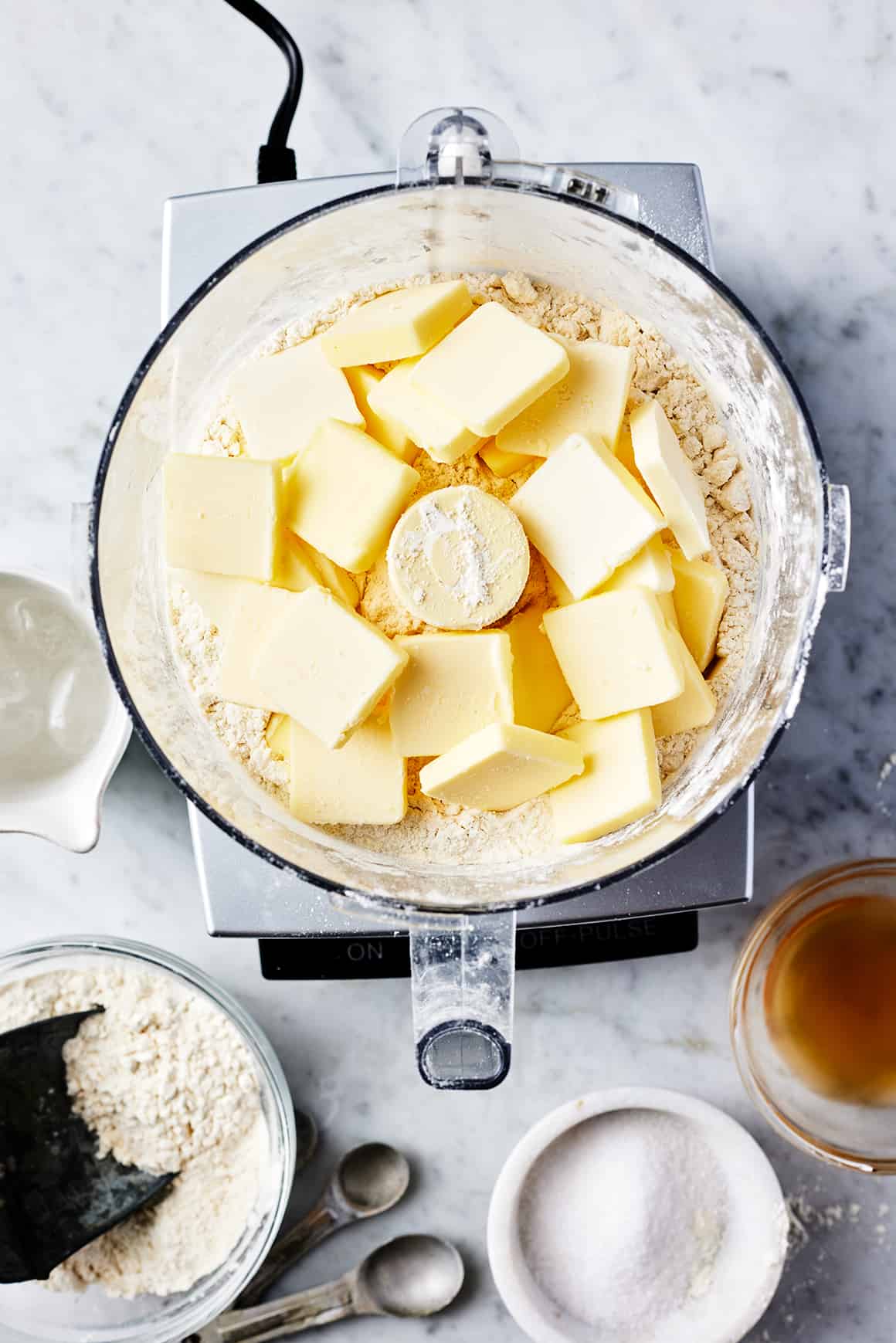
First, pulse the butter into part of the flour. Place 1 2/3 cups of the flour and the salt in a food processor and pulse to combine. Spread the butter on top.

Pulse until the butter is thoroughly incorporated with the flour and the dough starts to form clumps.
Before you move on to the next step, there should be no dry flour remaining.
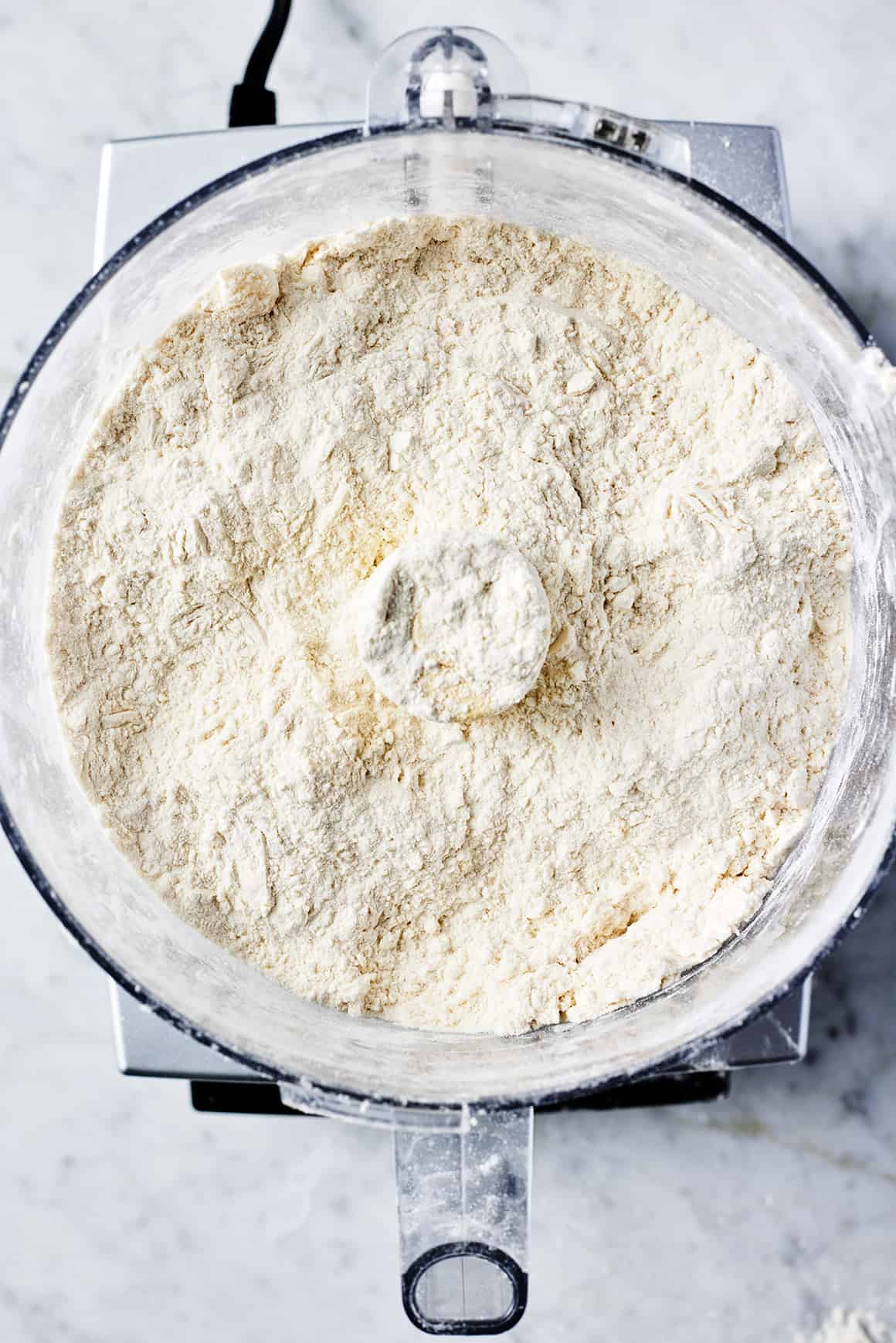
Then, add the remaining flour. Spread the flour/butter mixture evenly in the food processor and sprinkle the remaining flour on top.

Briefly pulse until the dough becomes crumbly.
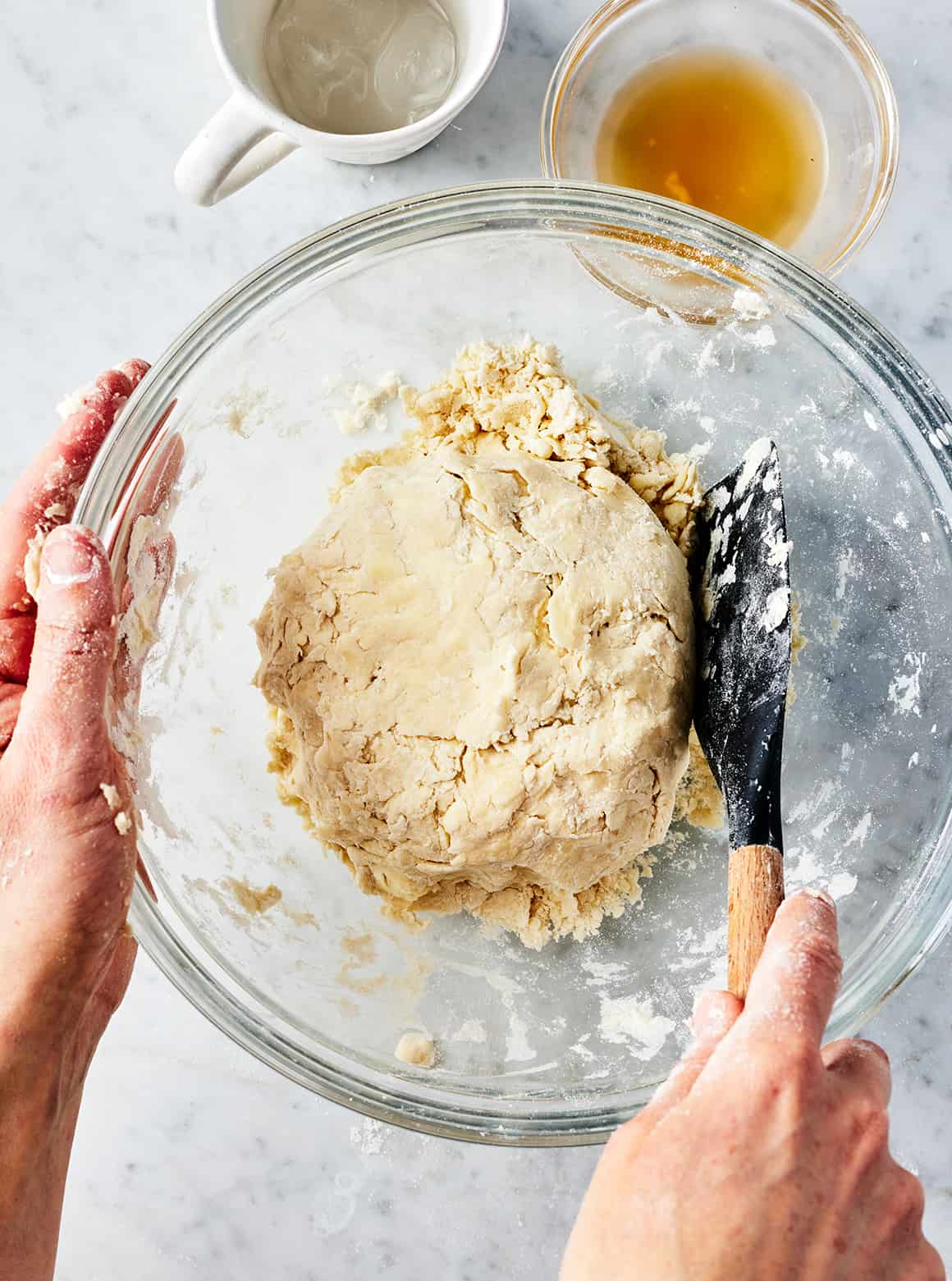
Next, add the liquid. Transfer the dough to a large bowl and sprinkle in the water and vinegar. Use a spatula to fold and press the dough until it comes together into a ball.
Finally, chill the dough. Divide it in half and flatten each half into a disk. Wrap tightly in plastic wrap and refrigerate for at least 2 hours or up to 2 days.
Rolling Out Pie Crust
Once the dough has chilled, you can roll it out and assemble your pie!
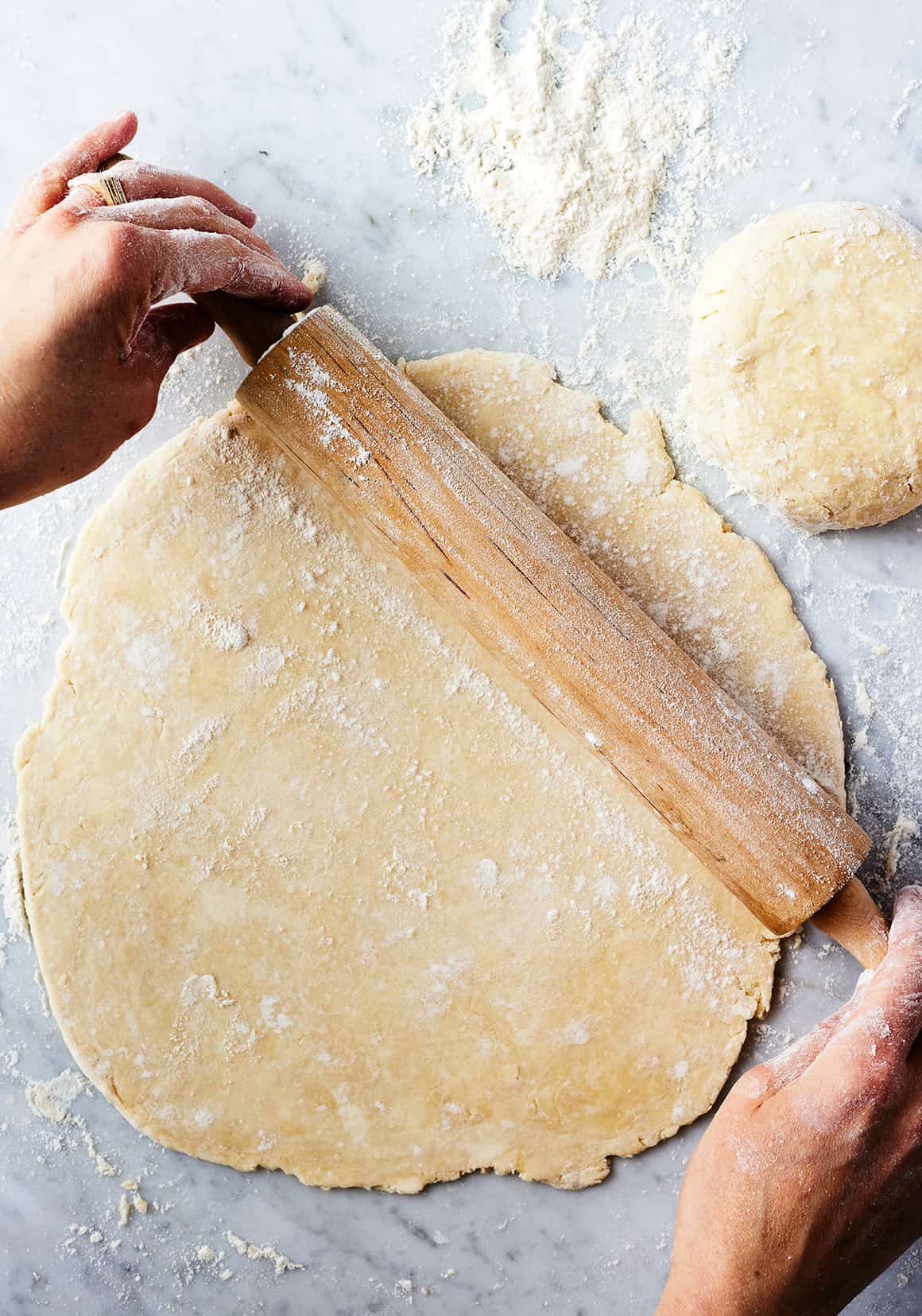
Place a disk of dough on a lightly floured surface. Dust the dough with flour and roll it out into a large 11- to 12-inch circle. It should be 1 inch larger than your pie pan on all sides.
Every few rolls, rotate the dough a quarter turn. This creates an even circle and prevents the dough from sticking to your work surface.
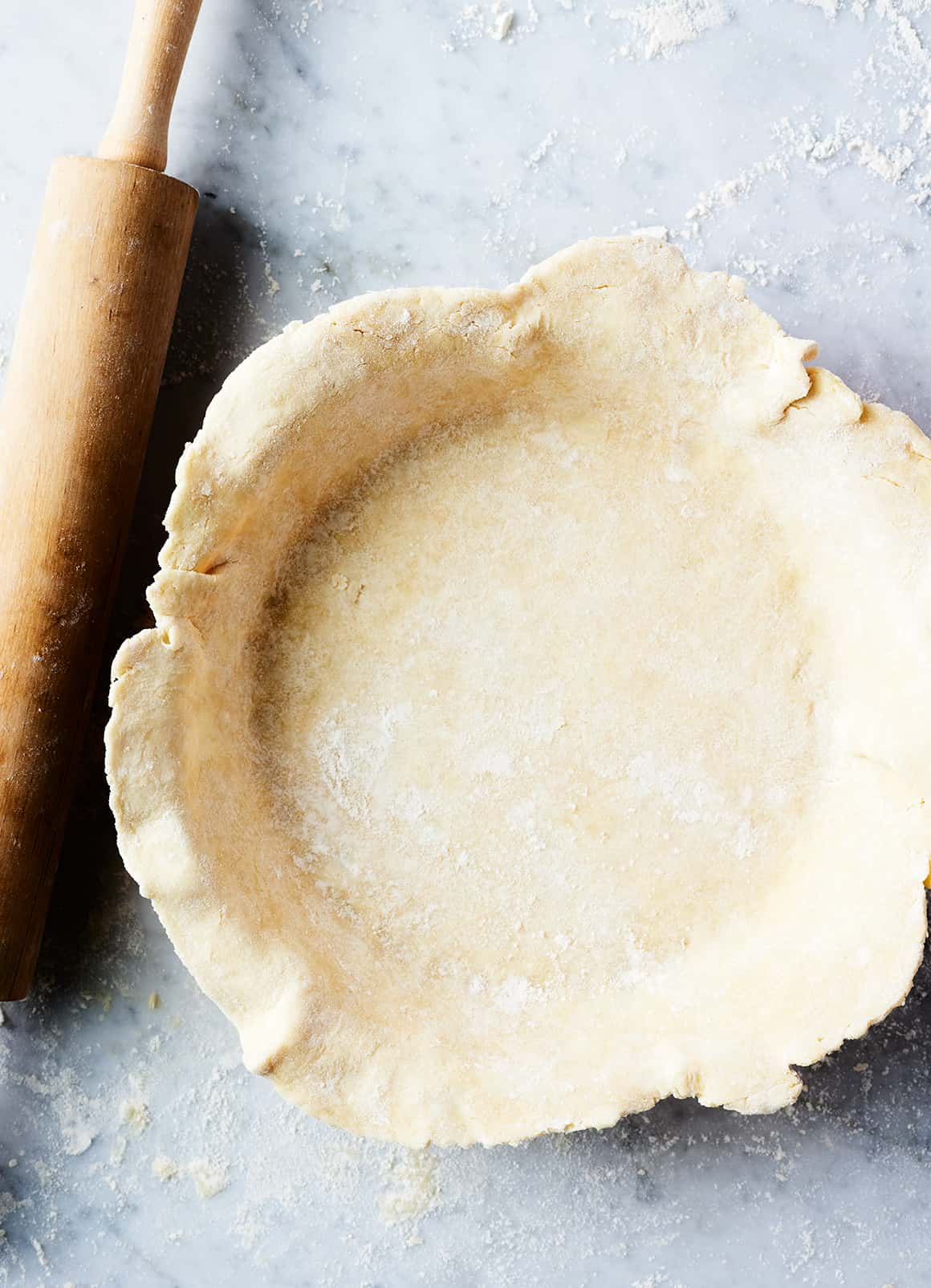
Finally, transfer the dough to your pie dish. Press it firmly into the bottom and up the sides.
If you’re making a single crust pie, use a sharp knife or kitchen scissors to trim any excess dough until you have a 1/2-inch overhang on all sides of the pie plate. Roll the dough under itself so that the edges are in line with rim of the pie plate. Crimp with your fingers or a fork, and follow your pie recipe to bake.
If you’re making a double crust pie, roll out the second disk of pie dough to make the top crust. Assemble and bake according to your desired recipe!
Recipe Tips
- Keep your ingredients cold, especially the butter. Pie crust becomes light and flaky when small pieces of butter in the dough melt in the oven, creating steam. If they melt before baking, when you’re working with the dough, the crust will be tough.
- Don’t skimp on the chilling time. This pie dough needs to chill for at least 2 hours before you roll it out. This gives the flour time to hydrate and the butter time to cool down. If you roll it out too early, it won’t bake into a flaky crust.

Blind Baking Pie Crust
Blind baking simply refers to pre-baking pie crust. You’ll often see it in recipes where the pie filling will cook through faster than the crust, like this quiche. Blind baking prevents the bottom crust from getting soggy. Here’s how to do it:
- Roll out the bottom crust, transfer it to your pie plate, and crimp the edges as desired. Loosely tent with plastic wrap and refrigerate while you preheat the oven to 425°F. Chilling the dough at this stage will help it hold its shape in the oven.
- Fill it with pie weights. When the oven is hot, remove the plastic from the crust and prick the bottom all over with a fork. Line the crust with parchment paper or aluminum foil, and add enough dried beans or pie weights to reach the top of the pie plate. Without the weights, the crust will shrink away from the sides of the pan as it bakes, so make sure to fill the pan all the way.
- Bake the crust with the pie weights for 15 minutes, until the edges are set.
- Bake the crust without the pie weights. Carefully remove the pie weights from the crust. Bake it for another 5 to 8 minutes, or until the bottom of the crust is beginning to set and turn light golden brown.
- Let it cool slightly before filling and baking your pie. That’s it!
Make-Ahead Pie Crust
Tightly wrapped in plastic, this homemade pie crust keeps well in the refrigerator for up to 2 days.
Feel free to make it ahead! If it’s too firm to roll straight from the fridge, let it sit at room temperature for a few minutes to soften.
Can you freeze pie crust?
Yes! Wrap it tightly in plastic and freeze for up to 3 months. Thaw overnight in the fridge before using.

Looking for pie recipes? Use this homemade pie dough to make my cherry pie, apple pie, or spinach quiche!

Easy Pie Crust
Ingredients
- 2⅔ cups all-purpose flour, spooned and leveled
- ¾ teaspoon sea salt
- 20 tablespoons cold unsalted butter, 2½ sticks, cut into ¼-inch pats
- 6 tablespoons ice water
- 1 teaspoon cold apple cider vinegar
Instructions
- In a food processor, place 1⅔ cups of the flour and the salt. Pulse to combine. Spread the butter pats evenly on top of the flour mixture. Pulse until the butter is well combined with the flour and the dough starts to form clumps. There should be no dry flour remaining.
- Spread the mixture evenly in the bowl of the food processor and sprinkle the remaining 1 cup flour on top. Briefly pulse until the dough becomes crumbly.
- Transfer the dough to a large bowl and sprinkle the water and vinegar on top. Use a spatula to fold and press the dough until it comes together into a ball. Divide the ball in half and form each half into a 1-inch-thick disk. Wrap each disk tightly in plastic wrap and chill for at least 2 hours or up to 2 days.
- To roll out the dough: Place 1 disk of the chilled dough on a lightly floured surface. Dust the top with flour and use a rolling pin to roll it out into a large circle about ⅛-inch thick. If you invert your pie plate over the dough, the circle should be 1 inch larger than the edge of the pie plate on all sides. As you work, rotate the dough a quarter turn every few rolls to prevent it from sticking to your work surface. I also like to dust the top of the dough with flour and flip it over a few times during the rolling process.
- To transfer the rolled-out dough to your pie plate, roll the dough over the rolling pin and unroll it over the pie plate. Use your fingers to press it firmly into the bottom and up the sides of the plate. Trim the edges of the dough so that there is a ½-inch overhang on all sides of the pie plate. Loosely cover the dough with plastic wrap and chill while you roll out the top crust.
- Repeat the rolling process with the remaining dough disk, rolling it out into a large, ⅛-inch-thick circle.
- Assemble and bake according to your desired pie recipe.








Hi Joe, It’s possible that scaling up the recipe may have caused some of the issues. Sometimes baking recipes can come out differently when they’re scaled up, and the larger batch would have been harder to work with in the food processor. I’m sorry that you were disappointed with the results!
Do you upload recipes in grams ever or would you post grams for this?
MY SEARCH IS OVER!! I have struggled for years to find a crust recipe that is easy to make, easy to roll, and bakes up tender and flaky, but I will look no more! Thank you for posting this, and know that you’ve made a huge difference for at least one person 🙂
Hi Pati, we’re so happy to hear that!
To be honest I did not care for this pie crust. Too difficult to make, uses way too much butter, and the result isn’t better than other easier and less expensive pie crusts I have made. I personally am fine with more “doughy” crusts though, I don’t need my crust to be like croissant dough, so it’s probably a personal preference thing.
Probably the easiest pie dough I’ve ever made is the “sour cream crust”, but it requires sour cream be on hand which is often a limiting factor.
Excellent crust. Easy to make, easy to work with, and delicious. This is now my go-to recipe.
Hi Lou, I’m so glad it was easy to make!
I’ve struggled over the years trying to find a pie crust recipe that was full proof and easy to work with. And the moment I tried your recipe, I was like where have you been. I’m telling I had given up. I started using frozen pre-made. Thank you for sharing. Which of your cook books can I find this recipe?
Hi Angela, so great to hear! I’m glad you loved the pie crust. At the moment, this recipe is just on the blog. We generally publish separate recipes online and in our cookbooks.
I continued the recipe entirely in the food processor. Pulsing as the cold water trickled down. As soon as it formed into a ball, I removed and divided the dough. It came out perfectly.
Hi Dana, amazing! So glad you had success making this in the food processor.
I’ve been making pies for several years with a good success rate. I have used different recipes and thought I’d try this new technique. It was easy enough with the food processor, but it never really came together in the bowl when adding the cold water and cider. with a spatula. I made the discs as well as I could and chilled them overnight, but alas, the next morning the dough was still loose and flourey. It only came together when I added more ice water. Will I try it again? Probably! With fingers crossed.
Hi Mia
I’m in Australia too so I googled it:
BUTTER STICKS CUPS TABLESPOONS OUNCES GRAMS
½ stick ¼ cup 4 Tbsp. 2 oz. 57 g
1 stick ½ cup 8 Tbsp. 4 oz. 113 g
1½ sticks ¾ cup 12 Tbsp. 6 oz. 170 g
2 sticks 1 16 Tbsp. 8 oz. (½ pound) 227 g
Good Luck. Glenys
How much is 20 tbspns butter in grams or ounces?
Vegan butter caution: Just made the dough according to the instructions but with plant based butter but have to make again with real butter. . Measured everything carefully but even with the second cup of flour there was no crumbliness and water and vinegar pretty much just sloshed around. Will try baking the result as a test in a couple of hours but am not optimistic. I’m sure it will be delicious made with dairy butter.
No. It’s a food processor recipe. There are lots of recipes for making pie dough by hand but this is not one of them.
I couldn’t find any instructions for making it without the food processor. Did I miss something?
Jeanine, could King Arthur’s gluten-free all-purpose flour successfully be used to make this crust? My niece isn’t able to consume any gluten.
I made this last night and it’s chilling in the fridge. Looks and feels like it’s super tough/stiff, is it normal?
Hi Vera, Did you change anything about the recipe?
Jeanine, my niece isn’t able to consume any gluten. Could King Arthur’s glute-free all-purpose flour successfully be used to make this crust?
Hi Carolyn, We haven’t tried using a gluten-free blend for this crust, so we can’t say for sure. I’d recommend looking for a pie crust recipe that specifically calls for gluten-free flour. If you’re open to a nontraditional crust, we love the pecan crust from this pumpkin pie recipe!
I like the idea of blind baking for my pumpkin pie, but won’t my edges risk getting overdone with the time required to bake the pie filling? I know I can use a pie rim to cover the edges but I’m not sure that will be enough to prevent over- browning.
Hi Traci, I blind baked this crust for a pumpkin pie last weekend, and it worked nicely! Because most pumpkin pies bake at a relatively low temperature, 350F or so, the crust shouldn’t brown too much. I would recommend baking the pumpkin pie with a pie rim or foil over the edges if you really want to manage browning – it will help! Have a great Thanksgiving.
Could you use vegan butter with this crust without changing the integrity of it?
Hi Ashley, We are planning to try this, but we haven’t yet, so I can’t guarantee the results. If you try it, let us know how it goes!
For this pie crust, would you recommend freezing it in the disc-form to have on hand?
Made a cherry pie using this pie crust recipe. My family loved it. They said it was the best pie crust they ever had. Thanks for sharing the recipe.
I’m so happy to hear!
This pie crust is fabulous! Haha, I made a cherry pie and my husband said, “ The best part of this pie is the crust.” It takes extra time due to the chilling, but is actually easy and so good. I made the dough one day and refrigerated the dough disks, then the next day made the filling, rolled out the crust and assembled. I hate store-bought crusts — they basically ruin what would have been a delicious pie. This is so easy and predictable using a food processor, I will never use a store-bought crust again.
Hi Evelyn, I’m so glad your pie crust came out so well!
Have you made gluten free pie crust ?
I’m sorry, we haven’t.